
Renewable energy sources have played a significant role in reducing India's carbon emissions and dependence on fossil fuels. By harnessing the potential of solar, wind, and hydro power, the transition towards a cleaner and greener energy landscape can be further accelerated in the country. By ensuring reliable and affordable electricity access for all, promoting renewable energy, and embracing technological and structural innovations, the Indian power sector is driving an inclusive development of the nation.
The power sector has witnessed steady growth, driven by rising demand, universal access to electricity and transition towards electric mobility. It has become a catalyst for various sectors, including manufacturing, agriculture, healthcare and education, fostering economic development and improving quality of life.
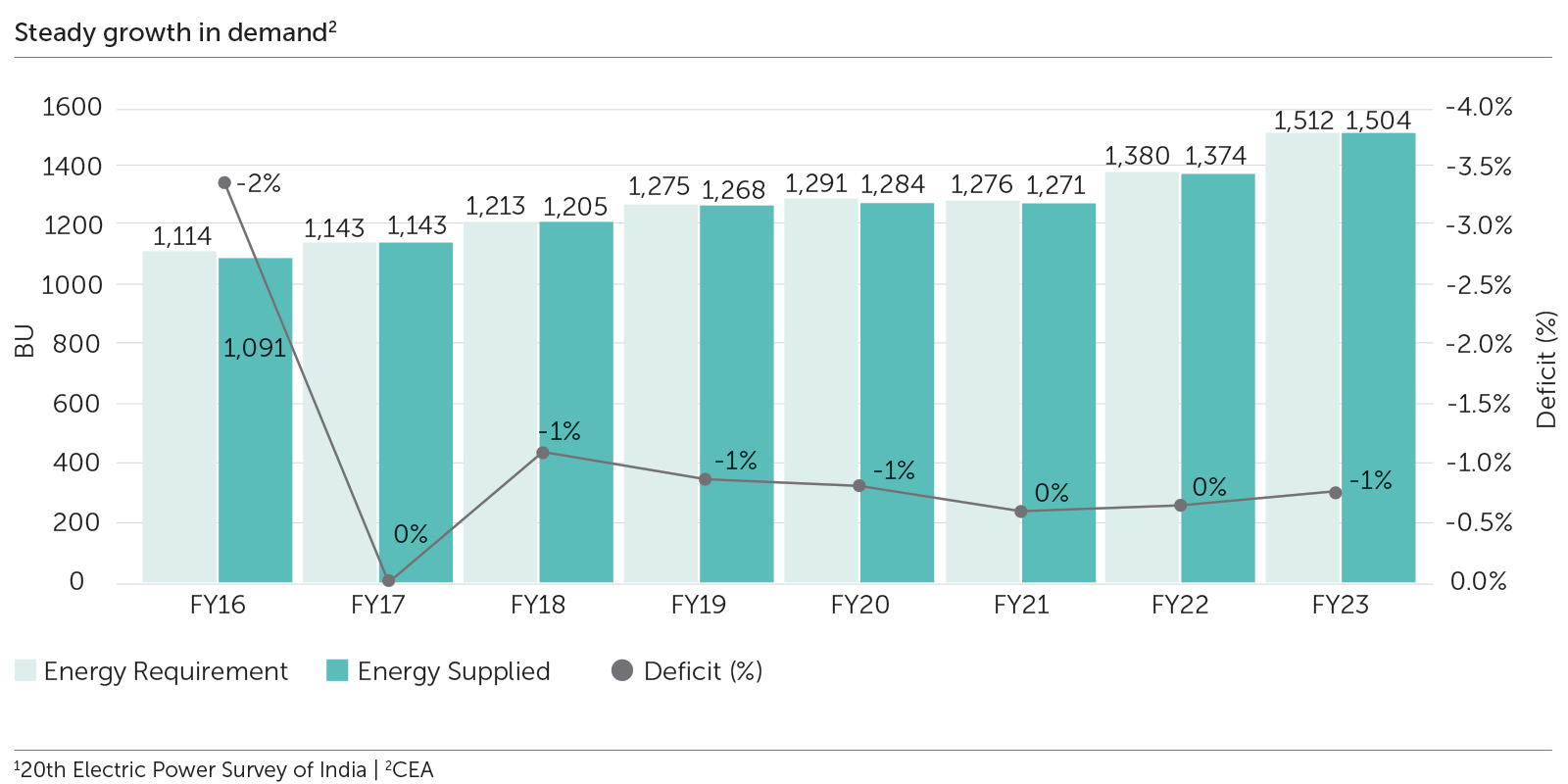
In FY23 India’s power consumption saw its highest ever year-on-year growth of 9.6% reaching 1,512 BU as compared to 1,380 BU in FY22. Along with high GDP growth which stood at 7.2% for FY23, a heat wave during summer of 2022 also contributed towards such a high demand. The projected GDP growth for FY24 is slightly lower, however with the focus on 24x7 supply along with growing EV utilisation, demand growth is expected to remain high for the coming year. Even in the long-term, demand growth is expected to remain high, which is estimated to reach 1,908 BU by FY27 and 2474 BU by FY321.
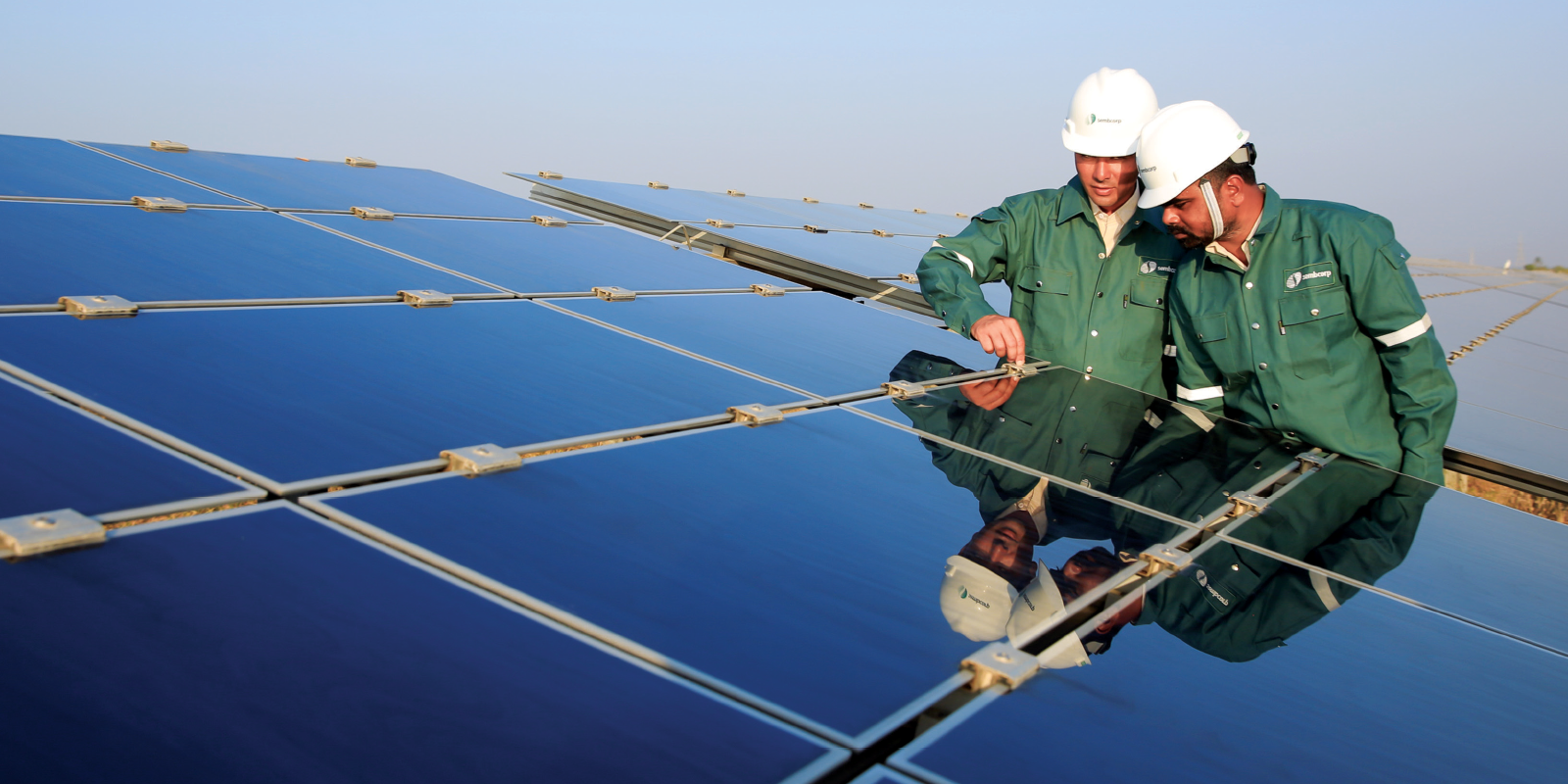
Significant efforts have been undertaken to enhance electricity generation capacity, improve transmission and distribution infrastructure, and maintain the focus on renewable energy sources, which have witnessed significant growth in recent years, in order to meet the growing demand.
The integration of renewable energy sources has also played a significant role in the growth of the power sector, reducing reliance on fossil fuels. In addition, advancements in technology have led to increased efficiency and
affordability in power generation and distribution, further contributing to its positive impact on various sectors of the economy.
Due to technological advancements in renewables and continued government support, the total generation capacity has reached 416 GW as of March 2023, of this around 51% is contributed by the private sector. Large-scale renewable projects, such as the development of solar parks and wind farms, have bolstered the renewable energy sector, which has supported diversifying the energy mix and reducing dependency on fossil fuels.


India is committed to becoming carbon neutral by 2070 and has set a goal of obtaining 50% of its energy from renewable sources by 2030. Thermal energy sources, especially coal, will be essential during the transition period. By adopting this approach, India hopes to accomplish two important objectives— assuring a steady supply to sustain economic growth while also accelerating the transition to cleaner sources.
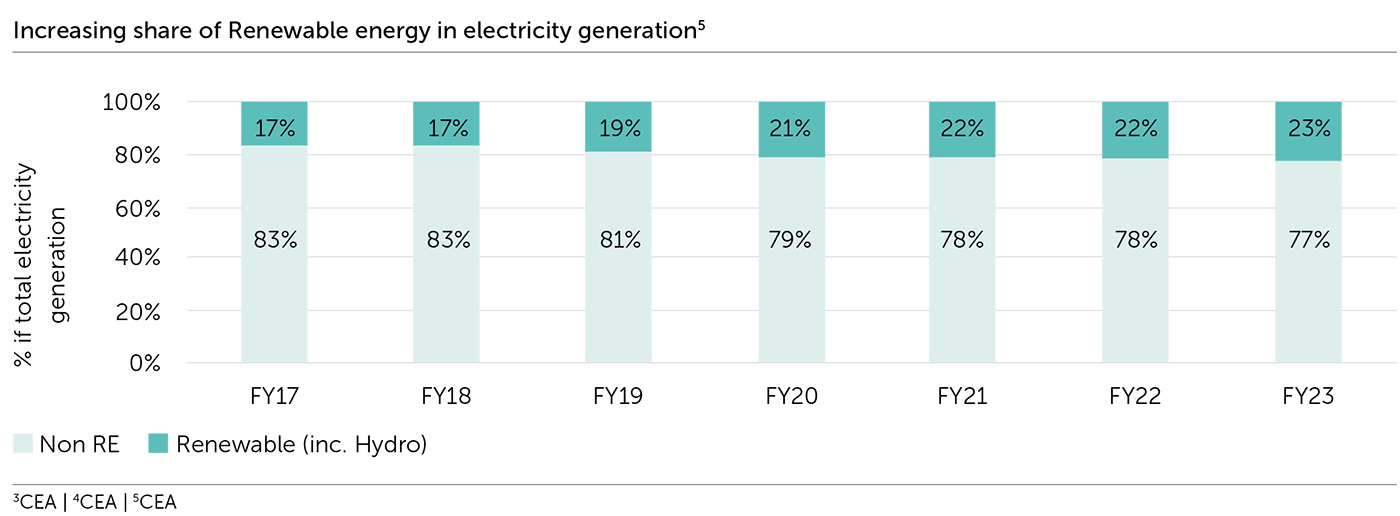
While renewable energy has enormous environmental and energy security benefits, its variable generation profile poses a challenge. Such increasing penetration of renewable energy presents a challenge in planning as well as operation of the grid. Thus, its benefits can be fully utilised only by striking the right balance with other dispatchable generation sources.
Recognising this, the government has encouraged investments to improve coal production to support thermal generation and has also issued supporting policies for development of storage systems. Also there has been now more focus on hybrid (wind-solar) bids to be able to provide round-theclock supply and optimally utilise the transmission system. This will ensure optimum balance in the sector resulting in economical, clean, and reliable power supply.
To address the issue of high receivables from the Discoms, the Ministry of Power issued Late Payment Surcharge Rules. These rules stipulated a time-bound EMI plan for payment of outstanding dues (including LPS till date of notification). Moreover, to regularise future payments for power procurement, discoms are either required to maintain adequate payment security mechanism (PSM) or make advance payments. Implementation of these rules has streamlined the payments process and is helping to bring down the receivables from the Discoms.
MoP recently issued an amendment of Electricity (Rights of Consumers) Rules which ensures 24x7 power supply to cities with population over 1 lakh. The interruptions are to be tracked by state authorities as part of indicators for Discom reliability. Further, to be able to improve cash flows of Discoms and implement demand side measures, such as implementation of TOD Tariff, pre-paid payments, timely subsidy distribution and so on, old meters of C&I consumers are to be replaced with smart/pre-paid meters. This will enhance growth in electricity demand and at the same time ensure good financial health of Discoms.
MEOF, through Environment (Protection) Second Amendment Rules, 2022, has categorised the thermal plants under three categories based on their distance from NCR and other polluted cities. Depending on the category of plant, emission norms are to be complied between December, 2024 and December, 2027. The amendment rules also provide for imposition of environmental compensation at rate of Rs. 0.20 to 0.40 per unit of generation in case of noncompliance
Multiple measures have been taken to increase the demand for renewable energy, which includes:
The Ministry has notified higher targets for total Renewable Purchase Obligations (RPO) at 43% by FY30, which include separate targets from Wind, Hydro, RE-based storage and other renewable sources.
Green Open Access Rules, 2022, have been issued by the MoP to solve concerns that have long prevented the growth of open access and to remove barriers to the availability and use of renewable energy. The rules call for lowering the open access cap from 1 MW to 100 kW, allowing smaller consumers to buy renewable energy. Provision for GEOA would support growth in renewables with the commercial and industrial consumers procuring power from renewables.
To provide supply side push, Renewable generation obligation (RGO) has also been introduced for the coal/lignite based plants getting commissioned after 1st April, 2023. Such plants are required to establish RE generating capacity of minimum 40% of the thermal capacity.
The MoP recently released a plan for flexible thermal/ hydro generation through bundling with RE power and BESS under existing PPAs. According to this plan, contracted coal- and hydro-power-based capacity are free to switch to renewable energy sources. MoP has set the trajectory for multiple thermal power to replace their coal-based power with RE power by operating the plants at lower PLF of 40%. It targets to replace 58 BU on energy basis with 30GW of RE capacity by FY26. Trajectory mentions the list of 81 plants with higher SRMC to replace their coal-based generation with RE power.
The Indian government has launched ‘National Green Hydrogen Mission’ with an initial outlay of Rs. 19,744 crore, including an outlay of Rs. 17,490 crore for the Strategic Interventions for Green Hydrogen Transition (SIGHT) programme. The mission aims to make India a global hub for production, utilisation and export of green hydrogen and its derivatives.


Green hydrogen production capacity of at least
per annum with an associated RE capacity addition of 125 GW in the country by 2030.

Cumulative reduction in fossil fuel imports over
per annum with an associated RE capacity addition of 125 GW in the country by 2030.

Over
in total investments

Creation of over
jobs

Abatement of nearly
of annual greenhouse gas emissions.
Phase 1 (FY23 to FY26)
The focus of Phase I will be on creating demand while enabling adequate supply by increasing the domestic electrolyser manufacturing capacity.
Phase 2 (FY27 to FY30)
The second phase activities would enhance penetration across all potential sectors to drive deep decarbonisation of the economy
MNRE has introduced a mechanism for pooled bids for power procurement from wind, ensuring capacity addition of 8 GW per year across all eight windy states. Bids will be processed through a single stage, closed process. This will end reverse auction process for wind bids for optimal tariff discovery.
MNRE has introduced a mechanism for pooled bids for power procurement from wind, ensuring capacity addition of 8 GW per year across all eight windy states. Bids will be processed through a single stage, closed process. This will end reverse auction process for wind bids for optimal tariff discovery.
Government took several steps to kick-start the offshore wind sector in the country. These, include:
A strategy paper for offshore wind energy was issued indicating the offshore wind auction trajectory of 37 GW by 2030. Off the coasts of Gujarat and Tamil Nadu, a total of eight zones have been identified as prospective offshore wind generation zones. The paper also specified three models to holistically develop offshore wind farms in the country.
Also, to mobilise international finance, offshore has been kept in the list of activities for trading of carbon credits under bilateral/cooperative approach.
The Government is targeting to issue bids equivalent to a project capacity of 4GW per year for an initial period for three years which will then be increased to 5GW per year for a period of five years (till FY30).
Exemption of additional surcharge for electricity produced from offshore wind projects, commissioned up to December, 2025.

General Network Access (GNA) is a significant modification to India’s grid access laws. Under the GNA, the injecting as well as drawee companies will have access to the grid regardless of the kind and length of the power procurement contract, as opposed to the former system of contract-based access and price.
For new projects, generators would have to take only the connectivity and they will be deemed to have access required for dispatch of power. Also, to enable accelerated growth in RE capacity addition, GNA regulations have provisions for timely completion of associated projects and penalties/ cancellation of connectivity in case projects do not come up in time.
Moreover, under the revised Sharing of Inter State Transmission System Charges Regulations, procurers alone— not generators—are now responsible for paying the costs associated with using the transmission system. Faster grid accessibility will result from this, which will promote a switch to marketbased power procurement. Additionally, it will bring relief to the plants with uncontracted capacity, as these plants were forced to obtain fixed cost basis un-tied LTA or short-term open access in order to dispatch their power.
For sale of power under the spot market, applicable ISTS charges were earlier based on the geographical location of the plant. With applicability of GNA, as generators will not have to bear the cost of ISTS charges, this will eliminate the disparity bringing all the plants to a level playing field.
Sharing regulations are now in line with the Ministry’s notification to waive 100% of the ISTS fees for the purchase of renewable energy for projects commissioned until June 2025. Post 2025, there will be staggered reduction in waiver till June, 2028. This will encourage commercial and industrial consumers to use open access routes for procurement of power resulting in development of an open access market for renewable energy.
Recently the central regulator has issued an amendment to Regulation on Deviation Settlement Mechanism (DSM), making it stringent compared to earlier DSM regulations. The slabs of deviation, from scheduled generation bands for renewable projects have been reduced. This will push the renewable generators to predict and schedule generation more accurately on day-ahead basis
Also, the role of individual participants for stability of grid will be majorly shifted to the grid operator, by developing a separate ancillary market. Apart from enhancing safety of the grid, this mechanism opens up opportunities for the generators, especially the ones which can quickly ramp-up / rampdown their capacities by providing grid support through ancillary services.
CERC came up with draft Indian Electricity Grid Code Regulation (IEGC). It has aligned these regulations with multiple developments in the sector including the Security constraints economic dispatch (SCED), DSM and Ancillary services, GNA and Connectivity Regulations and so on.
In accordance with the Act, rules, and notifications issued by the Central Government, IEGC also outlines the roles, responsibilities, and tasks of the relevant stakeholders related to the operation of the power system. All these will help in achieving maximum efficiency of the power system, it also specifies extensive provisions pertaining to:
Reliability and adequacy of resources.
Technical and design criteria for connectivity to the grid including integration of new elements, trial operation and declaration of commercial operation of generating stations and interstate transmission systems.
Protection setting and performance monitoring of the protection systems including protection audit.
Operational requirements and technical capabilities for secure and reliable grid operation including load generation balance, outage planning and system operation.
Unit commitment, scheduling and despatch criteria for physical delivery of electricity.
Integration of renewables.
Ancillary services and reserves.
Cyber security and so on.
The electricity exchange market has become more active as a result of the regulator’s periodic release of many regulatory modifications. Recently, the exchange market price saw a sharp rise in rates due to the unexpected surge in electricity consumption. To balance the interests of developers and the consumers, a price ceiling of Rs. 12 per unit was introduced. Further, to assure supply availability from sources where cost of generation is more than the specified limit of Rs. 12 per unit, a separate market product has been introduced as High Price Day Ahead Market (HP-DAM).
Overall, the Indian power exchange market has come a long way over the past decade. Exchanges which had power trade segments only up to 11 days now have been allowed a segment with longer duration contracts of up to 12 months. This will provide incremental trading volumes enabling opportunities for both sellers as well as buyers.

